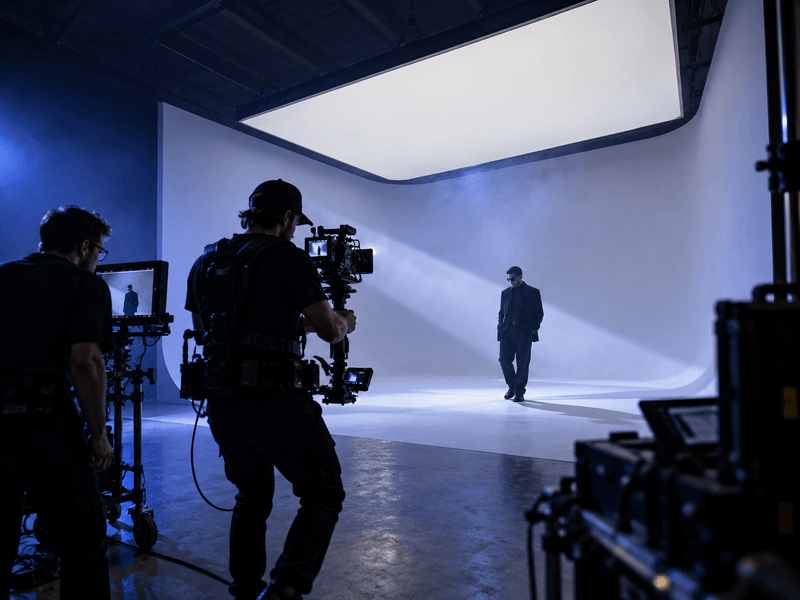
01 · WHITE CYC · LIGHTING
LIGHTING A 40-FOOT WHITE CYC WITHOUT MAKING IT FEEL FLAT.
A large white cyclorama gives a crew freedom, but it also exposes weak lighting decisions. The first choice is whether the cyc should read as pure white, soft gray, or as a shaped environment. At Manerk, the 40 × 25 × 16 ft U-shaped cyc and 15 × 25 ft overhead diffusion source let the background and subject lighting be treated separately.
For clean commercial work, consistency across the sweep matters more than simply adding more output. For fashion and beauty, controlling falloff and keeping contrast on the subject prevents the image from becoming visually flat. For video, the larger stage allows room for camera movement while preserving separation between talent, background, and fixtures.
The practical takeaway: decide what the cyc should look like on camera before deciding which fixtures to turn on. That keeps lighting intentional instead of just bright.
02 · FASHION · PRODUCTION FLOW
HOW TO PLAN A MULTI-LOOK FASHION SHOOT WITHOUT LOSING HALF THE DAY.
A fashion day becomes inefficient when every wardrobe change also requires a complete location and lighting reset. The better approach is to organize looks by what the production environment needs: clean cyc, painted backdrop, custom set, hard-light look, soft beauty look, or movement setup.
At Manerk, makeup, wardrobe, client review, lounge, lighting, backdrops, and sets are kept within the same production workflow. That makes it possible to prepare the next look while the current one is being photographed. When a custom set is involved, the first set can be prepared before call time whenever the scope allows.
A useful rule is to protect the camera department from avoidable resets. Group looks intelligently, pre-light where possible, and make wardrobe and set changes happen in parallel rather than one after another.
03 · SET DESIGN · CREATIVE DIRECTION
WHEN A CUSTOM SET IS WORTH BUILDING.
A custom set earns its cost when the environment is part of the campaign idea rather than just a background. If the visual depends on architecture, depth, reflection, sculptural shapes, drapery, platforms, portals, or a very specific color world, a physical build gives the camera real light interaction and perspective that a generic location cannot.
The strongest starting point is not a shopping list of props. It is a reference, emotion, composition, or campaign direction. From there, scale, materials, lighting access, camera angle, talent movement, and build time can be planned around what actually needs to appear in frame.
For productions with several looks, one strong hero environment can be paired with simpler backdrop or cyc setups so the budget is concentrated where the image benefits most.
04 · BACKDROPS · VISUAL STRATEGY
PAINTED BACKDROP OR FULL SET? CHOOSE BASED ON WHAT THE FRAME NEEDS.
A painted backdrop is often the better production tool when the visual needs color, texture, atmosphere, or tonal variation but does not need physical architecture. It is fast to light, easy to reposition, and lets wardrobe, product, and talent remain the focus.
A full set makes more sense when the camera needs depth, interaction, shadows from real objects, or a recognizable environment. The two can also work together: a painted surface can become the background layer behind platforms, furniture, props, plexi, or sculptural elements.
The production decision should come from the frame, not from the assumption that bigger automatically means better. The best solution is the simplest one that fully supports the idea.